Showing posts with label Writing Life. Show all posts

Jan 20, 2016

Writing Across Genres

I've spent the past 20 years writing in different genres, and I’m frequently asked how I do it. As the market grows and genres spawn sub-genres and sub-sub-genres, it’s become such a broad topic, I’m not sure anyone can actually cover the subject exhaustively. Several years ago, I asked
The members of my longest continuous running workshop to tell me what they'd want to hear if I did a workshop on the subject. They came back with a few suggestions, so I thought I’d share them here.

One asked: “How is writing a romance different from writing a mystery, different from writing a time travel in terms of mind-set, creative process, & plot?”

I think that every genre and sub-genre has its own language, its own rhythm, and its own feel. Short contemporary romances are far different from long contemporaries in terms of pace, rhythm, and language, and those are different from romantic suspense.

Romantic suspense is as different from traditional mystery as night from day, and time travel is completely different from fantasy romance. That’s one reason I was never a big supporter of the once-common wisdom to brush up a manuscript that had been rejected, lengthen it or shorten it, toss in a ghost or take the ghost out, and submit the manuscript to an entirely different publisher.

Submitting to a line that is similar in tone and texture is fine, of course, but I've heard editors comment about manuscripts that have obviously been redone, and I think authors make a mistake when they put themselves in that position.

I think it would take a fairly new editor without much experience not to recognize a short contemporary that's been turned into a long one, or vice versa. There's a big difference in the world view of the readers of the various genres, as well.

When I'm writing a long contemporary romance, I'm writing to people who believe that in spite of a few problems, life is generally good and love conquers all. The characters are rarely truly cynical people, and if one appears cynical, there is good underlying motivation for the attitude. In traditional romance, characters generally believe in the human race and they're fairly upbeat people as a general rule.

When I'm writing a time travel romance, I find that I can be a little more cynical about life, but I still have to write with the belief that love conquers all—even to the point of leaving behind everything that is familiar, everyone the character loves, and settling in happily in a new time period.

It’s personally very difficult for me to believe that someone could willingly walk away from loved ones, so when I write time travels I tend to make the traveler something of a loner, with very few people to leave behind. And the one time I didn't, the loss of his loved ones was an ongoing problem during the book.

Still and all, in time travel romance, fantasy romance, vampire romance, shapeshifter romance, or any other kind of paranormal or fantasy romance, the overriding belief is that anything is possible, even the impossible and that romance will win the day.

Inspirational romance, especially Christian-centered romance, will be decidedly different in tone than an erotic romance, and not just in the noticeable presence or absence of sex. The characters’ views on life, family, love, and politics will be vastly different. Their thoughts and thought processes will differ.

In romantic suspense, the life view may be even more cynical, and though love doesn't necessarily conquer all, it is a great healer. And, of course, as you move through all the various subgenres of romance and romantic suspense, things change a bit. But still, the language is romance language, in general a bit softer and more flowery (for want of a better description) and more introspective than some other genres.  

When writing straight mystery, love doesn't really play a part in the world unless love, the quest for it or the determination not to lose it, is the catalyst for the murder. In general, characters in these books don't have to believe that love conquers anything—and neither does the author.

Obviously, if the life view is different for each type of book, it's important to make sure that you're in the right mind-set when you approach the book.

If you have a somewhat cynical view of life and you're trying to write short, sweet contemporary without a lot of success, that difference may account for some of the problems you're experiencing.

If you've been raised to believe that sex before marriage is wrong and you're trying to break in to the market writing sizzling hot books, you may have trouble finding the success you want.

And if you see nothing wrong with a good roll in the hay on the first date, or if “date” is a loose description of the characters’ hook-up, but you're trying to break in by writing for a sweet market, you just might have the same problem.

Now, the truth is, that most of us have more than one side to our personalities, and that's where getting into the right mind-set becomes important.

I'm capable of feeling both cynical and optimistic about the world and the people in it, so making sure that I'm in the right frame of mind is vitally important when I move from one genre to another.

If I've just finished writing a murder mystery, that is the time for me to do my next mystery proposal while I’m still in that frame of mind.

The first thing I would do before sitting down to write a Harlequin Superromance was to read one or two just to get back into the right frame of mind and to begin to feel the rhythm of the speech for the book I needed to write and the world my characters were going to live in.

In general (and remember, I’m talking strictly in generalities here since there’s not time nor space to become more specific) mysteries and suspense novels flow at a different pace and use a different set of words than do their romance-genre cousins. Chapters are probably shorter. The pace is probably quicker. There’s much less introspection, especially about relationships with other characters.

Chances are, if you treat a romance reader to three pages of introspection about what a character is feeling and why, or how another character looks and what your POV character thinks about that, she’ll be perfectly okay with it. Offer a mystery reader three pages of introspection about any topic and you’ll probably lose the reader.

Writing across genres and absorbing pieces of different genres into your books may not be as difficult in these days where the publishing world has changed so drastically. Authors no longer have to convince an editor to take a chance on their work, but they still have to come across believably to readers. No matter how much you may love a particular story, if it doesn’t ring true to readers, you may not achieve the success you want with it.

Bottom line, the advice I would give to any writer today is the same advice I would have given twenty years ago: Read. Read, read, read. Read voraciously. Read all kinds of books. Understand reader expectations for the genre, subgenre or sub-subgenre you want to tackle. It’s the best kind of research any of us can do. 

Nov 20, 2015

More Thoughts on Focus

Continuing from yesterday's article on staying focused ... 

Do I do anything special to jog my brain into writing mode before I start writing? 

My answer at the time: 

Well, I used to. One of the things I've realized recently is that when I became a full-time writer, I lost some of the unconscious cues I gave myself that used to work so well. I used to get up every morning and go to work. Then I came home and spent time with my children until 9:00. 

At 9:00, they were on their own to get ready for bed and I began to write. They were not to interrupt me for anything that didn't include blood, but they could come in to kiss me good-night. They pushed the envelope at first -- after all, my youngest was only 5. But that was old enough, and she quickly learned that I meant what I said. 

I got up every Saturday and Sunday morning at 5:00 and wrote until the kids woke up and needed my attention. Note that I said woke up AND needed my attention because waking up did not automatically mean they needed my attention immediately. Like I said, my youngest was 5 then. She was old enough to watch cartoons for a little while and she could even fix herself a bowl of cereal (as long as the milk carton wasn't full.) 

My oldest was much older, and very self-sufficient, so if she ever woke up before the little one lost interest in cartoons, she could help entertain her sister. Not that she did. My oldest loved to sleep and the little one didn't, so I encouraged my youngest to become more self-sufficient. 

Anyway, that gave me at least four uninterrupted hours every Saturday and Sunday morning, and sometimes more. I did not allow myself to clean house, etc., until after my writing hours were over. There was plenty of time to mop the floor, but there wasn't plenty of quiet time to write. 

Once I began to write full-time, I must have unconsciously believed that I had unlimited writing time, even though I knew logically that I didn't, so I let guilt begin to niggle at me because it started feeling mean to tell the kids they couldn't interrupt me when I was working. Time wasn't so precious anymore, I guess. 

Little by little, I let the distractions creep in, so I'm just now in the process of developing habits again and mind-cues to let myself know it's time to work. I still get up at 5:00, and I spend at least one hour working on things for the writing classes I teach. 

After that, I allow myself an hour for RWA things (I was serving on the board of directors at the time). After that, I spend 30 minutes on my spiritual well-being. Then I know it's time to work. If I don't time myself on the class and RWA stuff, though, it can easily get away from me. 

It's 11:00 now and that's obviously not RWA time. Shame on me!!! Proof positive that I don't have it down to a science yet! But do I light candles and things like that? No. I've tried doing that, but it doesn't seem to send any signals to my brain except fear that the cats will knock over the candle and start the apartment on fire! Music helps. I do try to do that because it does help set the mood. 

My answer now: 

I'm still struggling to create a schedule I can stick to. Just when I think I've got it, something real life happens and it's impossible to stick to the schedule. Recently, I spent three weeks in Missouri taking care of my grandchildren while my youngest daughter was out of town for a wedding and I realized all over again how difficult it is to make and stick to a schedule with small children around. 

For the past two weeks, I've had to take three hours out of every work day to shuttle my daughter to and from work. We live in an area where there's no mass transit, so when her car broke down, mom taxi became the only option.  

On the plus side, getting up and dressed and out the door at a certain time every morning has made me focus on what I need to do when I get home again, so I've accomplished almost as much in my shorter work day as I usually do when I have all sorts of time stretched out in front of me. 

The difference has been so marked, in fact, that I have decided to create a daily commitment to get up and dressed and a commute for myself on work days once I'm no longer playing taxi. I'm hoping that a drive to the local convenience store and the purchase of a beverage of my choice every morning will help my brain click into work mode as I drive back home. 

As appealing as the concept of working in my pajamas may be in theory, my brain, accustomed to being in the work force for more than half my lifetime, reacts to pajamas at home as a day off. I can frequently glance at the clock and realize I've frittered away the entire morning without realizing it. 

Music is no longer a help to me. Since my youngest daughter had a frightening bout with depression during her senior year in high school, music makes me nervous and fidgety, so it doesn't help me write anymore. 

For a while, thanks to health concerns, it was almost physically impossible to focus, and that's a whole different set of challenges, especially when you have contractual obligations to be creative. 

I guess the thing is, focus is something we'll all have to struggle with and the struggle will take on new and different shapes in different seasons of our lives. Sometimes it may be a case of mind over matter, and giving yourself physical cues that it's time to work, like turning on the music or moving into your special writing space, may do the trick. 

Oh Winter, let's get married via photopin (license)
If you don't currently have a space dedicated to writing, think about creating one. Not everyone has the luxury of space for a home office, but moving to the same corner of the dining room table at the same time every day could help your mind realize it's time to create. 

When physical health issues aren't a problem, try not to let your muse dictate when you write. You'll always be able to find excuses for not writing. Those are much easier to come by than the determination to write. Get words on the page, even if they're stupid words you know you'll delete or revise later. 

Sometimes simple discipline, or BICHOK (Butt in chair, hands on keyboard) is the answer.  


Nov 19, 2015

On Staying Focused...

A few years ago, I was asked this question in one of my workshops: 

So my question is: I know you make a living by writing. So what are some tricks you've learned to help you schedule in the time to write and do you do anything before you start to write that helps you to be able to focus on your story and the characters?
My Answer: 

I think that being able to focus on writing is something that will probably haunt me as long as I'm pursuing a career in writing. Maybe it's that way for all of us. You may struggle for a while to focus, then hit a few years where it's relatively easy to focus, and then swerve off track again and find yourself struggling. 

We all know that many factors can affect our ability to focus - small children, teenage children, adult children, demanding husbands, people who think they need to eat three meals a day, friends with troubles they need to talk about, friends who unwittingly sabotage you, neighbors who don't understand, neighbors with noisy dogs, aging parents, personal illness, family tragedies, national tragedies, finances..... It's hard to keep focused, as we all know. 

A few years ago, I was tremendously focused. I wrote through major surgery--not the surgery itself, of course, but the recovery--without batting an eye. I just put pillows over my incision and a laptop on top of that, and I wrote. And wrote. And wrote. 

I wrote through several moves. I wrote in spite of family illnesses, deaths and funerals. I was focused because I knew where I was going, and I knew what I needed to do to get there. 

For the past few years, I've been struggling through a period of almost equally tremendous lack of focus--and that's one reason this topic appealed to me so much. Maybe because it's so important, and maybe just because I've been thinking about it so much and trying to figure out how to get my focus back. 

I think the main thing that helps with me focus is to clearly identify my goals--goals, not dreams. We all know what our dreams are, but for most of us dreams are things we can't control. You can't set a goal of becoming published with a traditional publisher because you can't accomplish that alone. But you can set a goal of being a writer because you make yourself into a writer, regardless of what anyone does with what you write. 

My first clear goal was to finish that first manuscript because I was very successful at beginning stories and a dismal failure at finishing. I decided that I would write to the end of one book, no matter what. No matter if it smelled like rotten fish guts in a hot sun, I was going to finish the stupid thing. And it did, but I remained true to my goal and I finished. I wrote it by hand because I didn't have a typewriter or a computer, but I finished it, by gum!

And suddenly, just knowing I could do that gave me a whole lot more focus. 

Maybe it seems silly to some people, but it took me a LONG time to really know in my heart that wishing I was a writer and talking about being a writer didn't make me one. Writing made me a writer. Persevering made me a writer. Learning my craft made me a writer. 


I also realized that nobody was going to knock on my door, announce that they'd heard I was a writer, and offer to buy books I hadn't written. Starting and never finishing wasn't going to get me where I wanted to go. 

I also had to learn in my heart (not in my head, that's the easy part) the difference between dreams and goals, the difference between those who want and those who do, the difference between those who wait for things to happen and those who make things happen. Maybe it's possible for some people to stay focused without a clear goal in mind, but it isn't possible for me. I know because I've tried -- over and over and over again. It just doesn't work, no matter how much I try to delude myself into believing that it does -- and I DO try. 

You have to know where you're going so you can plan how to get there. Specific goals divided into pieces I can accomplish with just a little will-power and discipline is an absolute must for me. 

Discipline is a biggie. I was talking to my daughter's drama teacher at parent-teacher conferences last week, and she talked at length about how she focuses on teaching the discipline because until you know the discipline of your art--whatever that art may be--you can't be free to express the art. 

That struck a real chord with me and I've thought about it a lot since then. I've known for a long time that discipline is one of the biggest factors that used to keep me so focused back when I was writing three or four 350-page novels every year. It's true of any art. The discipline comes first; the freedom of expression comes after that. 

And let's face facts. If you can't find the discipline to write when there's no pressure except what you create for yourself, you're going to have a tough time finding it when you're facing the pressure of writing a book under contract. Until you face that hurdle, you can't even imagine how much pressure it is. 


I froze for months after I sold my first mystery and my first romance and suddenly had to write under contract. Signing those contracts didn't fill me with the self-confidence I'd expected it to. Instead, I turned to stone. I found myself terrified that everyone would now realize what a fraud I really was. 

So discipline. Anyone who wants a career as an author must learn how to write in spite of life because life will never slow down, give you a break, or become easier. Identify what distracts you and then figure out how to eliminate or minimize the distractions. If e-mail (or social media) is a distraction (she said looking guilty) then find a way to reduce the distraction. Don't allow yourself to log on until after you've produced pages. 

If the TV is a distraction, find a way to turn it off (there's this little thing called a remote....) or figure out a place to write where you can't hear it. If kids are a distraction, bribe them. If the phone is a distraction, turn off the ringtone or set up a signal your children and spouse can give you so you know it's them calling and train yourself to ignore any ring that isn't them.

Figure out exactly how important writing is to you. If all these other things (like e-mail and TV shows) continually get in the way, then have a really stern talk with yourself and figure out what you really want. Do you want to be a writer? Really? Are you ready to do everything that means? 

Or do you just want to have written a book? 

Because if you want to be a writer, then the act of actually writing must become a priority in your life and you must train yourself and the people around you to accept that, even if they don't understand it. 

If, on the other hand, you want to have written a book but the act of actually writing it holds no appeal--well, that's something you need to know.

-----------------------------------

Since writing that original answer, I've encountered more road blocks and more speed bumps, and I've had more of a struggle with staying focused than ever before. 

Once I thought it was all a case of mind over matter. 

Now I know that some things in life are way too big to think your way around. Sometimes you have to let your mind grapple with survival--your own or that of a loved one--and there may be no room for writing or creating when that happens. 

Now I know that if you're battling an illness yourself, your mind may not be able to get around even the simplest matter, like where you put your keys or how to find a mechanic to work on your car, much less creating an entire world out of nothing. 

Now I know that sometimes it's not enough to want something desperately. Sometimes, you need to take a step back and let yourself heal. 

If you're there, you know it. Don't let anyone try to convince you otherwise. Be kind to yourself. Be patient. Be gentle until the crisis has passed. 

If your health is good and you haven't just gone through an internal, emotional earthquake, and you're still having trouble writing, consider the possibility that you’re approaching your work from the wrong angle. Wrong characters? Wrong plot? Wrong location? Is the motivation strong enough? Is the conflict realistic? 

Consider the possibility that you’ve made everybody too nice and you’re boring yourself. It can happen. Trust me. Or maybe you're making your characters too unrealistically awful, without any redeeming social value. 

Consider the possibility that your characters aren't emotionally invested in the plot you've created, even if it seems like a perfectly good plot to you. Remember that absolutely nothing you've planned is so wonderful you can't afford to toss it and replace it with something that works. 

Consider the possibility that you're letting fear get the best of you. In that case, put your head down and get to work. 

(See tomorrow's blog post for more on this subject)

Nov 5, 2015

Four Books I Must Have at All Times

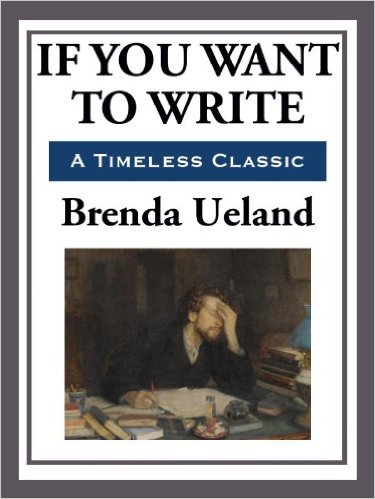
If You Want to Write by Brenda Ueland

This was the first book that made me really, really want to be a writer. Before I read this book, I kinda, sorta wanted to write, but Brenda Ueland left me feeling that I actually could be a writer, and that feeling did more than anything else to give me the courage to actually give it a try. 

For years, I've shared quotes from this book with people who have taken my workshops on writing. 

“The imagination needs moodling,--long, inefficient happy idling, dawdling and puttering. ” ― Brenda Ueland

It was this quote, more than probably any other, that made me believe, suddenly and with great awe and wonder, that I might be able to actually do the thing I wanted to do more than anything else: 
"This is what I learned: that everybody is talented, original and has something important to say." --Brenda Ueland
I think that anyone with the creative spirit should read this book once every few years. It's time for me to read it again. 

On Writing: A Memoir of the Craft by Stephen King

I'm going to confess here that I have never read a work of fiction by Stephen King, although after reading his book On Writing, I can't say why. His book about the craft of writing is so brilliant, I'm quite sure I'd appreciate his other work. King is unfailingly honest and realistic, sometimes uncomfortably so. This isn't a how to write book, it's straight-forward advice about how to approach your career.  
“Amateurs sit and wait for inspiration, the rest of us just get up and go to work.”  ― Stephen King, On Writing: A Memoir of the Craft
“If you don't have time to read, you don't have the time (or the tools) to write. Simple as that.” ― Stephen King 
This is another book I think we should all read again and again. 

Techniques of the Selling Writer by Dwight V. Swain 

When I began my writing career, I'd been an aspiring, hopeful, wannabe writer for years. I'd started and not finished more novels than I can possibly count. It wasn't until someone recommended that I read this book that I understood the basics of storytelling well enough to actually craft a story worth reading. 

Over the years, many people have given us their spin on what Swain has to say, but for my money, this book trumps them all. Yes, some of the examples are a bit dated, but that doesn't matter. They hold up. They stand the test of time. 
 “A story is the record of how somebody deals with danger.” ― Dwight V. Swain, Techniques of the Selling Writer
"I cannot give you the formula for success,” says Herbert Bayard Swope, “but I can give you the formula for failure: Try to please everybody.” ― Dwight V. Swain, Techniques of the Selling Writer
This book is an absolute must on my bookshelf. It's one I refer back to time and time again. 

The Elements of Style by William Strunk, Jr. and E.B. White

I think I would have to give up my writer's card if I left this book off the list. Yes, it was written a long time ago. Yes, the language is sometimes difficult for some to read and understand. Deal with it. The advice is sound. It has stood the test of time. If you aspire to be a storyteller of note, you'll buy this one, read it, and keep it handy at all times.  
“A sentence should contain no unnecessary words, a paragraph no unnecessary sentences, for the same reason that a drawing should have no unnecessary lines and a machine no unnecessary parts.” ― William Strunk Jr., The Elements of Style
“Form the possessive singular of nouns by adding 's. Follow this rule whatever the final consonant. Thus write: Charles's friend, Burns's poems, the witch's malice. ... The pronomial possessives hers, its, theirs, yours, and ours have no apostrophe. Indefinite pronouns, however, use the apostrophe to show possession: one's rights, somebody else's umbrella. A common error is to write it's for its, or vice versa. The first is a contraction, meaning "it is". The second is a possessive. It's a wise dog that scratches its own fleas.”  ― Strunk Jr., William, The Elements of Style
 I own many more books on writing. My shelves are filled with them, and some of them are very fine books. I've learned much from many people and I'm grateful to each of them for sharing what they've learned and how they learned it. I could fill endless blog posts with all the great books on writing I've run across over the years, and I may do a follow-up post later and do just that -- but if you want to know the books I must have on my shelf, on my e-reader, and near at hand at all times, these are the four that top that list. 

If you haven't read them, I encourage you to do so now. You won't regret it. 

Oct 15, 2015

Thoughts From a First-Time Conference Attendee

While sorting through some files on my computer, I came across an article I wrote 20 years ago after attending my first-ever Bouchercon. I was a newly published author, venturing into the world of other published authors for the first time. I'd never been to any large writer's conference at the time, so the whole thing was a new experience to me. 

In the years since, I've been to several large writer's conferences and even presided over one during my year as President of Romance Writers of America. I've written 30-something books and seen many of them published around the world. I'm pleased to say that most of my observations have stood the test of time. And so, here they are, seeing the light of day for the first time in two decades: 

NOTES FROM BOUCHERCON
                                
Recently, I had the opportunity to attend the Bouchercon World Mystery Convention in Seattle.  This was my first national convention of any kind, and I don't mind admitting the idea of attending this convention of over 1600 authors, agents, editors and fans--of which I knew not one living soul--made me a little nervous. But I'd spent a lot of money on airline tickets and hotel reservations, and I decided not to let it go to waste. 

As I battled my fear of the unknown, I realized that unless I brought something back, the trip would be a waste. So I squared my shoulders, took a deep breath, and acted like a big girl. 

I had a wonderful time. I spent a lot of time watching others, much energy meeting new people, many hours smiling--and even more money. I met Marcia Muller in the Dealers' Room. I met Tony Hillerman in the lobby. I met my agent, my publisher, and several editors from my publishing house. I smiled for pictures, ate too much for dinner, plugged my book and admired the view from various places. 

I met wonderful, exciting new authors who've written wonderful, interesting books. And I started a list. Things I want to remember. Things I'll do differently next time. One or two things I'll do the same. In case you're interested, I'll share my list with you:

NOTES FROM BOUCHERCON: 

Register early enough to get a room at the conference hotel.

Always Wear Your Name Tag

Use Your Pseudonym. That's the name you want people to remember. 

Writers who have achieved true success don't talk about how well-liked they are or how talented they are or how well-liked their books are.

Many writers who haven't, achieved real success do talk about those things--a lot..
Even million-sellers are insecure about their work.

Many authors refuse to show their work to anyone except a spouse or significant other. (At the time, I thought it was because they were afraid someone would tell them their plotting or characterization was weak. That might be the case with some authors, but having gone through several different seasons in my own work, it may also just be that they are in a place with their career where they need to pull back and keep their work to themselves.) 

Editors are anxious to find good books. 

Nobody can clearly define what a "good book" is. 

Published authors don't attend many workshop sessions. 

Work the Dealers' Room. (Or whatever they call the bookseller area of your conference. Meet the people who will be selling your books.) 

Be on a panel (or give a workshop. Like anything else in life, ultimately you'll get out of the experience just what you put in.)

Go to everything your publisher sponsors--they'll usually notice if you're not there.

Don't believe anyone who tries to convince you otherwise.

Don't tell editors how nice it is to discover they're "real people". They don't seem to like this much. 

Read everything your publisher puts out in your line.

Make friends with writers who are at the same stage of their career as you are. (Don't try to crash the "big kid" table. Just like school, if you stick with it, one day you and your colleagues will be the big kids.)

Don't be shy. (Yes, I know that most of us are introverts and it's often painful to act extroverted, but being a wallflower won't accomplish anything. Show an interest in other people. Don't waste so much time thinking about yourself. It's not all about you.) 

Don't be pushy. (It's still not all about you.)

Invest time and effort in your career.  Arrange signings, attend conferences, accept speaking engagements. 

Mystery writers can't agree on technique or style any more than any other group of writers can.

The private parties are the best.

Make an appearance everywhere. Your editors will be looking for you.

Readers and most unpublished authors are willing to listen to anyone speak. They'll listen to you, too. They're anxious for tips, insight into the writer's world, and in technique.

Published authors only really listen to authors who sell more books than they do.

And even then they don't pay much attention--they've got an editor who likes their work and they're not real anxious to fix what's not broken.

The people at your publishing house want your books to sell as much as you do.

I heard a vicious rumor that some publishing houses are going start to requiring video tapes of potential authors to see how promotable you are. (I don't know if anyone ever did this, but being promotable is still a thing

People judge your work by the image you project.

Be approachable and accessible. People will remember you next time.

Be familiar with other peoples' work. (Again, not all about you.) 

Spend time in the hospitality suite.

Sell yourself -- tastefully.

Remember names!

Send thank you cards to everyone.

______________________________

Have I followed every bit of this advice over the years? No, but I still think most of it is valid and I'll review it before I go to my next conference. So there it is for you, whatever it's worth.

Dec 17, 2010

20 "Rules" for Writers


1.    Believe in your talent.  Your desire to write is no accident. 

2.    Dare to imagine.

3.    Don’t think about publication while you’re creating. Your muse probably works well under certain types of pressure, but may shut down under the pressure of trying to make your book fit a publisher’s guidelines. Making it fit is a job for your internal editor. So create with joy and abandon. Write as if no one will ever read what you’ve written. You can always worry about “fixing” it later. 

4. Don’t undervalue your internal editor. She has a specific job to do, so when the time is right, move your creative self out of the way and let your editor get to work.

5.    Remember the reader’s journey.  Give her what she came for. Never make choices in your writing based on what’s easiest for you to do. It’s always about the reader.

6.    Don’t try to sound like a writer. It will kill your work.

7.    Leave your ego at the door. 

8.    Try something new every day. 

9.    Leave the page once in a while.  Get outside and live! 

10.  If what you’ve been doing isn’t bringing you the success you’re looking for, try something else.

11.  Writer’s block may just mean that you’re approaching your work from the wrong perspective. The muse often shuts down when we try to force the wrong thing onto the page. 

12.  Accept change. 

13.  Don’t expect approval for telling the truth. 

14.  Every experience in your life has purpose -- both the good and the bad.  Embrace them all.  They’re here to give you something to say. 

15.  Remember that novel writers are, by nature, risk-takers. Take risks. 

16.  Forget about critics. Reviews, both good and bad, can impact your creativity negatively. If the review is bad, you’ll begin to doubt yourself and your talent. If the review is good, you’ll either worry about whether you can do it again, or you’ll begin to believe your own press and lose the hunger that gave you that edge.

17.  Forget your parents, your siblings, your children and your neighbors when you sit down to write. 

18.  Tell your truth and the truth of your characters.  Don’t worry about anyone else’s. 

19.  What you don’t write does not exist in your characters’ world. 

20.  There are no rules


 ----------
Dancing on Coals Online Workshops
http://www.dancingoncoals.com