Showing posts with label Craft. Show all posts

Jan 20, 2016

Writing Across Genres

I've spent the past 20 years writing in different genres, and I’m frequently asked how I do it. As the market grows and genres spawn sub-genres and sub-sub-genres, it’s become such a broad topic, I’m not sure anyone can actually cover the subject exhaustively. Several years ago, I asked
The members of my longest continuous running workshop to tell me what they'd want to hear if I did a workshop on the subject. They came back with a few suggestions, so I thought I’d share them here.

One asked: “How is writing a romance different from writing a mystery, different from writing a time travel in terms of mind-set, creative process, & plot?”

I think that every genre and sub-genre has its own language, its own rhythm, and its own feel. Short contemporary romances are far different from long contemporaries in terms of pace, rhythm, and language, and those are different from romantic suspense.

Romantic suspense is as different from traditional mystery as night from day, and time travel is completely different from fantasy romance. That’s one reason I was never a big supporter of the once-common wisdom to brush up a manuscript that had been rejected, lengthen it or shorten it, toss in a ghost or take the ghost out, and submit the manuscript to an entirely different publisher.

Submitting to a line that is similar in tone and texture is fine, of course, but I've heard editors comment about manuscripts that have obviously been redone, and I think authors make a mistake when they put themselves in that position.

I think it would take a fairly new editor without much experience not to recognize a short contemporary that's been turned into a long one, or vice versa. There's a big difference in the world view of the readers of the various genres, as well.

When I'm writing a long contemporary romance, I'm writing to people who believe that in spite of a few problems, life is generally good and love conquers all. The characters are rarely truly cynical people, and if one appears cynical, there is good underlying motivation for the attitude. In traditional romance, characters generally believe in the human race and they're fairly upbeat people as a general rule.

When I'm writing a time travel romance, I find that I can be a little more cynical about life, but I still have to write with the belief that love conquers all—even to the point of leaving behind everything that is familiar, everyone the character loves, and settling in happily in a new time period.

It’s personally very difficult for me to believe that someone could willingly walk away from loved ones, so when I write time travels I tend to make the traveler something of a loner, with very few people to leave behind. And the one time I didn't, the loss of his loved ones was an ongoing problem during the book.

Still and all, in time travel romance, fantasy romance, vampire romance, shapeshifter romance, or any other kind of paranormal or fantasy romance, the overriding belief is that anything is possible, even the impossible and that romance will win the day.

Inspirational romance, especially Christian-centered romance, will be decidedly different in tone than an erotic romance, and not just in the noticeable presence or absence of sex. The characters’ views on life, family, love, and politics will be vastly different. Their thoughts and thought processes will differ.

In romantic suspense, the life view may be even more cynical, and though love doesn't necessarily conquer all, it is a great healer. And, of course, as you move through all the various subgenres of romance and romantic suspense, things change a bit. But still, the language is romance language, in general a bit softer and more flowery (for want of a better description) and more introspective than some other genres.  

When writing straight mystery, love doesn't really play a part in the world unless love, the quest for it or the determination not to lose it, is the catalyst for the murder. In general, characters in these books don't have to believe that love conquers anything—and neither does the author.

Obviously, if the life view is different for each type of book, it's important to make sure that you're in the right mind-set when you approach the book.

If you have a somewhat cynical view of life and you're trying to write short, sweet contemporary without a lot of success, that difference may account for some of the problems you're experiencing.

If you've been raised to believe that sex before marriage is wrong and you're trying to break in to the market writing sizzling hot books, you may have trouble finding the success you want.

And if you see nothing wrong with a good roll in the hay on the first date, or if “date” is a loose description of the characters’ hook-up, but you're trying to break in by writing for a sweet market, you just might have the same problem.

Now, the truth is, that most of us have more than one side to our personalities, and that's where getting into the right mind-set becomes important.

I'm capable of feeling both cynical and optimistic about the world and the people in it, so making sure that I'm in the right frame of mind is vitally important when I move from one genre to another.

If I've just finished writing a murder mystery, that is the time for me to do my next mystery proposal while I’m still in that frame of mind.

The first thing I would do before sitting down to write a Harlequin Superromance was to read one or two just to get back into the right frame of mind and to begin to feel the rhythm of the speech for the book I needed to write and the world my characters were going to live in.

In general (and remember, I’m talking strictly in generalities here since there’s not time nor space to become more specific) mysteries and suspense novels flow at a different pace and use a different set of words than do their romance-genre cousins. Chapters are probably shorter. The pace is probably quicker. There’s much less introspection, especially about relationships with other characters.

Chances are, if you treat a romance reader to three pages of introspection about what a character is feeling and why, or how another character looks and what your POV character thinks about that, she’ll be perfectly okay with it. Offer a mystery reader three pages of introspection about any topic and you’ll probably lose the reader.

Writing across genres and absorbing pieces of different genres into your books may not be as difficult in these days where the publishing world has changed so drastically. Authors no longer have to convince an editor to take a chance on their work, but they still have to come across believably to readers. No matter how much you may love a particular story, if it doesn’t ring true to readers, you may not achieve the success you want with it.

Bottom line, the advice I would give to any writer today is the same advice I would have given twenty years ago: Read. Read, read, read. Read voraciously. Read all kinds of books. Understand reader expectations for the genre, subgenre or sub-subgenre you want to tackle. It’s the best kind of research any of us can do. 

Dec 9, 2015

An Unbending Honesty

In my previous post about finding what’s wrong in your work, I said that I think writers need to understand the structure of a scene to identify what’s wrong with a scene.

Another thing I strongly believe a writer needs is an unbending honesty with himself. This means you have to tell yourself the truth, not what you want to hear. This is tough to do, especially if we’re in the habit of smoothing our own ruffled feathers in other aspects of our lives. If we’ve learned how to pat ourselves on the head and make ourselves feel better over real-life issues, we should at least suspect that we’re capable of doing the same thing when it comes to our writing.

If you want to strive for excellence, you need to be honest—both about what’s wrong with your work and what’s right. No running yourself down relentlessly, indulging in false modesty and refusing to acknowledge your strengths. No glossing over your weaknesses.

One thing I clearly remember from my early days as a writer was making the decision to read the work in hard copy rather than on the screen when I’m revising. I think doing that is one of my subconscious triggers. As long as it’s on the screen, it’s “mine.” Once it’s printed on the page, I find it easier to distance myself from it. To read it as if someone else wrote it. Unless I do that, I can’t honestly determine whether I’ve hit the bar I’ve set for myself.

The first time I sat down to read a manuscript I wrote from beginning to end, I talked to myself long and hard about forgetting that I’d written it so I could approach it with some detachment. I believe this is another key element in being able to identify what’s wrong. As long as we remember that it’s our work, we retain a deep personal attachment to every word, to every scene, to every idea on the page.

When you sit down to read something you’ve written—whether it’s a page, a scene, a chapter, or an entire manuscript—remind yourself that nothing is sacred. Absolutely nothing.

It doesn’t matter how long or hard you’ve worked on a scene, how much you like a particular description or phrase—if it doesn’t fit, if it doesn’t feel right, it needs to go.

If a character or a location isn’t working, he goes, she goes, or it goes. Absolutely nothing is sacred. Absolutely nothing is safe.

If you’re approaching your work feeling protective in some way, determined to preserve, to fix, to keep what you’ve written, you are automatically shutting down some of the internal voices that will help you identify problem areas before you even begin.

To find the flaws in what you’ve written, you have to remain logical. Logic and sentiment don’t work well together. Sentiment will allow you to keep contrived and unbelievable situations because you like them or you don’t want to work as hard as you need to in order to fix them.

If you’re a discriminating reader, logic will pinpoint those problem areas immediately. You’ll know what works and what doesn’t. And that’s when you need to remember that ideas are just ideas. Words are only words.

Much as we like to talk about pouring our blood and our souls into our work, ideas are still just ideas. No matter how often we wax eloquent about the “book of my heart,” words are still just words.

When you’re looking at a scene, a chapter, or an entire manuscript and trying to figure out what’s wrong with it, remember that you’re looking at the whole picture, not just a single element. If you’re focused on a beautifully written sentence, for example, you might not be able to sense that it’s actually making your character seem weak or ineffective, or that it’s making a character behave out of character. You might not recognize that the character’s motivation is weak, or that the emotion you’ve written for her is contrived.

Remember also that an idea doesn’t make a plot. Ideas are everywhere. Some ideas can be spun into plots, but ideas and situations are not plots all by themselves.

Plots have—here comes that word again—structure.

If you don’t fully understand what your plot should be doing, it will be very difficult to identify when your plot isn’t doing it.

Does your plot have an inciting incident that’s big enough to drive the plot forward? Are your characters sufficiently motivated to keep them moving when things get tough? Does your scene contain actual conflict, or is it full of anticipated or remembered conflict?

Is your character spending too much time thinking about what just happened or what’s going to happen? It’s possible that too much time in his own head will make him feel self-centered and selfish, and that you’re losing sympathy for him without even realizing it?

Is he falling in love with a weak character or one who is TSTL (Too Stupid to Live?) Is the antagonist he’s facing too weak to present a challenge that will keep readers engaged? Are you relying on an unrealistic coincidence to either move your plot forward or bring it to a conclusion?

Do you have actual turning points, or is your plot plodding along on a predictable path? How many times has your protagonist thought about his or her goal, motivation and conflicts? Are you presenting new information to the reader, or are you rehashing stuff they already know?

Be honest with yourself. Don’t ignore those flickers of doubt. Don’t automatically assume the doubt is justified, either. But at least give it some honest consideration before you duck and run.

If you feel that something’s wrong with your story, but you don’t know what it is, ask yourself when you last felt that the story was absolutely right. Go back to that point and read what you’ve written to see if you’ve taken a wrong turn.

Have you forced a character to follow a pre-determined path just because you once decided that’s what needed to happen? Should you have listened to the character when he said that’s not how he felt and wanted to go in another direction?

Another big question I would have for anyone who has trouble identifying what’s wrong in their own work is: How much do you read?

I’ve said this before, and I’m certainly not alone. Reading is not optional if you want to be a writer.

Are you reading at least one book a week?

When you read, what are you reading? Are you reading the work of authors who are where you want to be? Are you reading outside your chosen genre? Are you opening yourself to ideas beyond what other authors in your genre have used? Even if you're writing sweet contemporary romance, you can learn a lot from someone who writes fantasy or action/adventure or mystery, or even (gasp!) literary fiction.

If all you ever read are books from one genre, how will you identify if you're relying on genre cliches to carry your work?


Are you constantly and consistently studying the medium in which you’re trying to work, or do you put off reading, (the necessary study of your craft) because there are other things to do?

Do you write consistently and regularly? When you sit down to write is there any discipline involved in what you’re doing?

If the answer to any of those questions is no, then I have one more question for you—how do you expect to understand what’s wrong with your work?

If you’re not working at your craft—and I mean really working, not playing, not talking about it—if you’re not actively trying to improve your understanding of the craft and practicing what you’ve learned, and stretching yourself a little more every day.

If you’re not studying by immersing yourself in the work of other authors who are where you want to be, then how do you expect to know when you get there?

As I said before, you need to clearly understand where you’re heading before you’ll even have a clue whether or not you hit the mark.

You need to earn the understanding you’re looking for. No one can hand it to you. You can’t learn it from reading a book--or even this workshop. The best teacher in the world, the best critique partner in the world, the best how-to book in the world can’t do a thing to help you if you’re not willing to help yourself.

And willing doesn’t mean intentions. Willing means action.

Yes, we can learn from others. I wouldn’t write this blog or offer workshops if I didn’t believe that. But ultimately, we learn from doing. We learn by write by writing. By trying someone else’s technique or suggestions, seeing if it works for us, and either keeping it or discarding it.

We learn by trying new techniques and perfecting the old.

So go.

Write things!

Dec 3, 2015

Identifying What's Wrong in Your Work

We all know that creating is an art, but editing is absolutely a science. Unless you understand the tools of your craft, the scientific part of what we do as writers, I’m not sure a person can ever really identify what’s wrong with something they've written. 

A writer must know what should be happening in the work, in literary terms, in dramatic terms, in terms of structure, before he can identify what’s missing.

We can’t necessarily command the artistic part of what we do. Nobody can truly control art. But we can command the rest. Write like a wood sprite in a meadow if that's what works for you--but then pull out your tools and get to work making all those pretty words into something solid. 

No matter how exciting we may think a story idea sounds, it’s not going to rise to the level of excellence if we aren’t in command of the craft while we write it. We must know the tools of our trade. We must have a clear understanding of the structure of a scene and how all the components fit together before we can identify when one of those components is missing or weak.

Simply reading about scene- or plot-structure isn’t going to cut it. The only way I know to truly learn anything in this business is by doing it. Not just once. Not just 10 times. Not just 100 times. But over and over and over again.

If you’re having trouble identifying what’s wrong in your own work, stop and think about this honestly—how many scenes have you crafted, being true to the “science” of scene structure? How many times have you clearly identified your character’s goals and then made absolutely certain to keep your characters moving toward those goals as the scene progresses?

Like any other artistic endeavor, writing takes practice. Most adults can string words together to make a sentence, but being a writer is much more than that. So if you’re approaching your scenes haphazardly, writing whatever seems kind of right, “kind of” understanding goals, but not really. Kind of moving toward them—but usually not . . . 

Or moving toward them only by accident, then it’s going to take a whole lot of luck to figure out what’s wrong when they don’t work right.

Intending to use scene structure one of these days or to get structure into your scene by osmosis isn't the same as identifying where the support beams go and making sure the load-bearing walls of your scene are in place. Thinking is not the same as doing. 

Thinking about it or talking about it won't give you the same level of skill that you’d get if you actually worked at learning scene structure, worked at writing scenes using it, and worked at polishing and revising those scenes again and again until you knew, deep in your own gut, that you had it right.

If you’re trying, then abandoning it because it’s hard, or because you don’t get it, or because it takes too long—or for whatever reason you may be deciding not to use it, then I don’t know what to tell you about how to find what’s wrong in your work.

Because the structure that I follow—that I believe in absolutely—is how I find what’s wrong in my own work.

And it’s how I identify what to do to fix it.

If you’re approaching a scene that you feel is weak and rambling, then the only thing I can suggest is to look at the scene’s structure. Does your viewpoint character have a clear goal?

Do your non-viewpoint characters have clear goals that are in opposition to that of the point-of-view character? Does the viewpoint character move steadily and relentlessly toward achieving that goal? Do the non-viewpoint characters move steadily and relentlessly toward achieving their goals?

Is the conflict clear? Is it interesting? Does it move the story forward or is it repetitive action—just more of the same thing we’ve already seen? Is it real, active conflict, or is it anticipated conflict (a character thinking about what might go wrong) or remembered conflict (a character thinking about what did go wrong)?

Are you deep enough in the character’s head and heart to convey clear emotion? Is that emotion real, or is it merely convenient for you, the author, so you can move your characters to the next place you’ve decided they should be?

Do you understand the character’s motivation? Is it believable? I mean really believable, not conveniently believable, or I-don’t-have-time-to-rewrite-it believable, or genre-cliché believable. If you were in that character’s shoes in the same set of circumstances, would you do the same thing? Or are you trying to force characters to do things simply because they sound good for the plot you’ve made up?

How much do you understand about the “science” of characterization? How much do you understand about the science of conflict and motivation? How did you come by that understanding? From working relentlessly on your own work or from reading what somebody else says about it?

Do you know absolutely, on a gut level, what comprises a strong scene? The pacing you should be following in the book you’re writing? Do you have a clear, working understanding about the layers of conflict and how best to weave them together? Because if you don’t know what’s right, how can you expect to figure out what’s wrong?

A doctor can’t diagnose congested lungs unless she knows what clear lungs look and sound like. A mechanic can’t diagnose a dead battery unless he knows what’s supposed to happen when the battery is working right. A musician can’t diagnose music being played off-key or in the wrong rhythm unless she knows what the key is supposed to sound like or understands the rhythm as it’s supposed to be.

Bottom line: An author can’t identify what her scenes aren’t doing unless he knows what they’re supposed to do in the first place. Putting the magic in fiction takes a lot of hard, gritty, realistic work. 

Nov 5, 2015

Four Books I Must Have at All Times

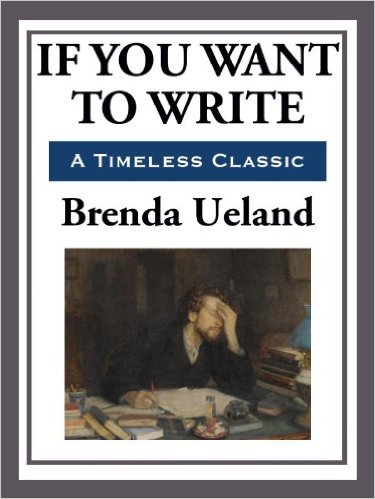
If You Want to Write by Brenda Ueland

This was the first book that made me really, really want to be a writer. Before I read this book, I kinda, sorta wanted to write, but Brenda Ueland left me feeling that I actually could be a writer, and that feeling did more than anything else to give me the courage to actually give it a try. 

For years, I've shared quotes from this book with people who have taken my workshops on writing. 

“The imagination needs moodling,--long, inefficient happy idling, dawdling and puttering. ” ― Brenda Ueland

It was this quote, more than probably any other, that made me believe, suddenly and with great awe and wonder, that I might be able to actually do the thing I wanted to do more than anything else: 
"This is what I learned: that everybody is talented, original and has something important to say." --Brenda Ueland
I think that anyone with the creative spirit should read this book once every few years. It's time for me to read it again. 

On Writing: A Memoir of the Craft by Stephen King

I'm going to confess here that I have never read a work of fiction by Stephen King, although after reading his book On Writing, I can't say why. His book about the craft of writing is so brilliant, I'm quite sure I'd appreciate his other work. King is unfailingly honest and realistic, sometimes uncomfortably so. This isn't a how to write book, it's straight-forward advice about how to approach your career.  
“Amateurs sit and wait for inspiration, the rest of us just get up and go to work.”  ― Stephen King, On Writing: A Memoir of the Craft
“If you don't have time to read, you don't have the time (or the tools) to write. Simple as that.” ― Stephen King 
This is another book I think we should all read again and again. 

Techniques of the Selling Writer by Dwight V. Swain 

When I began my writing career, I'd been an aspiring, hopeful, wannabe writer for years. I'd started and not finished more novels than I can possibly count. It wasn't until someone recommended that I read this book that I understood the basics of storytelling well enough to actually craft a story worth reading. 

Over the years, many people have given us their spin on what Swain has to say, but for my money, this book trumps them all. Yes, some of the examples are a bit dated, but that doesn't matter. They hold up. They stand the test of time. 
 “A story is the record of how somebody deals with danger.” ― Dwight V. Swain, Techniques of the Selling Writer
"I cannot give you the formula for success,” says Herbert Bayard Swope, “but I can give you the formula for failure: Try to please everybody.” ― Dwight V. Swain, Techniques of the Selling Writer
This book is an absolute must on my bookshelf. It's one I refer back to time and time again. 

The Elements of Style by William Strunk, Jr. and E.B. White

I think I would have to give up my writer's card if I left this book off the list. Yes, it was written a long time ago. Yes, the language is sometimes difficult for some to read and understand. Deal with it. The advice is sound. It has stood the test of time. If you aspire to be a storyteller of note, you'll buy this one, read it, and keep it handy at all times.  
“A sentence should contain no unnecessary words, a paragraph no unnecessary sentences, for the same reason that a drawing should have no unnecessary lines and a machine no unnecessary parts.” ― William Strunk Jr., The Elements of Style
“Form the possessive singular of nouns by adding 's. Follow this rule whatever the final consonant. Thus write: Charles's friend, Burns's poems, the witch's malice. ... The pronomial possessives hers, its, theirs, yours, and ours have no apostrophe. Indefinite pronouns, however, use the apostrophe to show possession: one's rights, somebody else's umbrella. A common error is to write it's for its, or vice versa. The first is a contraction, meaning "it is". The second is a possessive. It's a wise dog that scratches its own fleas.”  ― Strunk Jr., William, The Elements of Style
 I own many more books on writing. My shelves are filled with them, and some of them are very fine books. I've learned much from many people and I'm grateful to each of them for sharing what they've learned and how they learned it. I could fill endless blog posts with all the great books on writing I've run across over the years, and I may do a follow-up post later and do just that -- but if you want to know the books I must have on my shelf, on my e-reader, and near at hand at all times, these are the four that top that list. 

If you haven't read them, I encourage you to do so now. You won't regret it. 

Oct 28, 2015

So You Want to Plot

To create a plot that will hold the reader’s attention from beginning to end, we need to begin at the tip of the iceberg, not at the summit, not on the downhill slope. We begin at the tip and then force out characters to go up, over and across the iceberg, not around it where the going is easy.

We make them face every dangerous moment as they traverse the obstacle that’s in their way. We don’t lessen the danger. We don’t send help. We don’t toss them a rope or put a ladder under their feet.


Start with what each of the characters in your story wants. Make sure it’s something they can’t achieve or acquire easily. It should be something they can’t ask another person for and can’t run out and buy. It took me a long, long time to realize that a character who doesn’t really want something—and want it badly—is next to impossible to motivate in difficult situations. As a result, I ended up putting those characters into contrived situations, and then wrote myself into very deep corners I had trouble getting out of.

To avoid my mistake, make sure your character wants something so badly he’ll do almost anything to get it. Make it something he aches for or something upon which his future, or the future of others, depends. The character’s motivation must be strong enough to propel the story forward, even when you’ve boxed him into a corner.

Does that concept make you recoil? Do you think it’s too extreme?

You want to write about simpler things. Stakes that aren’t quite so high. Passion that’s a little less ... passionate. Wants that are less earth-shaking, less life-altering.

But do you really?

If the people you’re writing about aren’t one-hundred percent committed to pursuing their goals, willingly or not, they’re going to be too easily discouraged when things get rough. They’re more likely to back down, turn away, give up, move on, shift goals, and go after something else until things get rough.

Once you give a character an out, he’ll probably take it. If he doesn’t, what comes next may feel contrived.

source
To write really compelling fiction, you must write about people who are completely committed. Passionate people who are willing to fight for what they want and keep going after it in the face of obstacles, right or wrong, wise or foolish. Just keep your idea in view, your motivation appropriate, and the people in your story behaving in character.

A word of warning (another lesson learned by doing it the other way): Characters who want to achieve a negative goal, to avoid something, to prevent something, to run from something, also make for unworkable (or very tough) fiction.

If you create a man who wants, for example, specifically, not to fall in love, anything you put into your plot that makes him fall in love is likely to feel forced. Why would a person who truly wants to avoid the opposite sex open the door, even a little, for that perky Heroine you’ve just shoved under his nose?

People who want negative goals (who want to avoid creating something new in their lives) don’t have to actually do anything to accomplish their goal. In fact, all they really have to do is keep doing the same thing they’re doing now. Creating a character arc for someone with a negative goal is difficult and painful because making that character move and change requires you, the author, to lie, Readers can always, always, always feel a lie, even if they can’t identify it as one.

Books about people who don’t change, move, grow, or step outside their comfort zones are generally not well received. Books about people who make changes, move, grow and step outside their comfort zones unrealistically also get a lackluster response from the reading public.

We want to read about someone with a problem he can’t avoid, a plan for getting around it, and the courage to take active steps toward succeeding with the plan.

Instead of having your romance hero wake up in the morning vowing never to fall in love again, let him want something instead—something that gets him moving forward. He’s accepted the fact that he won’t find love again, but he wants desperately to regain the respect he once had from people in his chosen field. Because he wants a positive (respect) rather than a negative (to not fall in love) he may reluctantly open the door for that perky Heroine he views as a negative because she offers the means to the end he seeks.


Thinking about your plot in those terms can give you goals for your characters, motivation that keeps the story moving, and believable conflict all in one! 

Oct 8, 2015

Bringing Characters to Life Through Emotion

To bring a scene to life, your characters need to come fully to life. One thing that will kill a scene faster than almost anything is an author so obviously intent on getting the characters to pose here, say that, and do the other the characters never become real people and never actually connect with each other. Characters that don’t connect with each other on the page have very little chance of connecting with the reader.

Don’t let yourself get so caught up in the need to drop witty one-liners, a piece of research, or an exciting fight sequence onto the page that you keep your characters from reacting honestly. Don’t be so concerned about getting a line of dialogue into a scene that you write cardboard characters who talk at each other rather than real people who talk to one another.

Forgetting that our characters are supposed to be in the same room engaging in conversation with one another is a common mistake. It's actually a form of telling rather than showing because the author is so focused on her own part in the story that she’s not letting the characters live the story. As a result, the reader ends up wading through several paragraphs or pages of narrative explanation or paragraphs full of uninteresting dialogue when what she really wants is to get on with the story.

Getting the mix of emotion right isn’t easy. If it were, none of us would struggle with it. While we want to make sure we include enough emotion, there are times when less is more.

Be careful not to confuse emotion with sentimentality. Sentimentality is simplistic, surface emotion. It’s clichéd, affected emotion, which shows only the surface without foundation. Editors are looking for real emotion, even if—especially if—it’s raw and painful. With the increase in technology, I think more people are writing and submitting today than ever before. Years ago, only the most dedicated writers were willing to mess around with carbon paper and typewriter erasers. Now that we can all point and click, cut and paste, the competition has exploded.

Your characters’ emotions are one of the few things that will make them stand out in that vast sea of similar characters out there. In the past two months, I’ve judged two contests for published writers. I’ve read 16 books for the two contests, all of which obviously made it past slush-pile readers, onto an editor’s desk, and through the editorial process.

Of those 16 books, 10 had plots so similar it would boggle your minds. (It still boggles mine.) Luckily, the books for one contest were final round picks, so they were above-the-norm when it came to the writing, the plotting, the motivation, and conflict, but those elements were also very similar. The only thing that set the books apart from one another were the different casts of characters in each book. Unfortunately, since the books were also eerily similar, their perspectives on life—their emotions—were the one true thing that made the characters unique in each book. 

For that reason, it's imperative to dig deep and discover what your characters really feel about their situations. Not what you think they might feel, or what similar characters usually feel by page ... whatever ... of your genre-specific work-in-progress, but what that unique individual you're writing about feels based on his background, his belief system, and the kind of day he's having.

Once you can tap into a character's genuine emotions, he or she will truly begin to come to life on the page of your manuscript. 


photo credit: via photopin (license)

Oct 1, 2015

To Plot or Not to Plot

No doubt you’ve heard (and probably participated in) debates over which is best—plotting in advance, or writing off into the mist. I have no doubt that you have a preference, because just about everyone does. 

Although we can sometimes get into heated debates, we all know that there really is no right or wrong way. No one-size-fits-all solution to the question of how to get from the beginning to the end of your novel. The important thing is to achieve the desired effect, to pull readers into our stories and keep them hooked from the first page to the last.

Whether you plot before you begin to write, as you begin each section of the book, or sit down every day with no conscious idea where your book will be going that day, we all plot. Even those who write into the mist plot in some way at some time, either consciously or unconsciously, or they wouldn’t end up with a story.

But let’s begin at the beginning.... What is plot? 

Plot is probably the most often-heard term when writers get together to discuss fiction. Most people consider it the essence of fiction. Without plot, there is no story. While some people begin with plot and then look for characters to enact that plot, others begin with interesting people and discover their plot by looking into the characters’ lives. Either way, plot is story.

There are many definitions of plot floating around out there. Plot is
  • an ordered structure of significant events;
  • the story of strong forces meeting and one of them triumphing over the other for better or worse;
  • a record of change.

 An ordered structure of significant events. Okay, I guess that’s true. If I’m describing my plot to an editor, an agent, or a potential reader, I’ll want to give an ordered structure of story’s significant events, so yeah. That describes plot as I know it. 

Plot is the record of strong forces meeting and one triumphing over the other, for better or worse. I agree with that, too. Plot is all about the conflict, about a person who wants something, meeting strong forces that keep him from getting what he wants, and his eventual triumph over or defeat by those forces. 

Plot is a record of change. I agree with that, too. Change alters people’s fortunes, their thoughts, and their beliefs—even if it’s only long-held beliefs about themselves. Change is what readers come to the book to find. I doubt you’ll ever run into a reader who picks up a book hoping for 400 pages in which everything in the characters’ lives remains exactly as it was on page 1.

Plot is also a force upon the people in your story, often called narrative drive. This drive is the relentless forward movement of events, and the details related to those events, that pile up until the whole teetering tower collapses into the final conflict—those climactic scenes that make the story worthwhile.

We need that force working on the people in our stories because, again, readers don’t come to the book to find out what happens in the life of someone who never experiences something beyond their control, never ends up with their back against the wall, or never has to fight their way out of a bad situation. So change isn’t enough. It needs to be a change that challenges the character to climb higher, dig deeper than s/he ever has before.

It’s a rare person who will stick with a book about nice people to whom nice things happen repeatedly until the story ends. As an author, I wouldn’t know when to stop writing if the people in my book had nothing to conquer or nothing to concede defeat to by the end. 

Readers need plot—that relentless forward movement—to keep them hooked. Authors need plot to know when and where to begin, and when and where to stop. 

In the past, I've worked with many confused writers who had no clear idea of how and when to begin the book they want to write, no clear idea where they’re going, and no clue where to end. This is a horrible feeling. It leaves a writer feeling unequal to the task they’re facing, which might be okay if they weren’t driven to face that task, tackle the book, and conquer it—a mini-plot in itself!

We’re all terribly afraid that our plots won’t work and worried that we are the rare thing among writers—the one and only author who can’t come up with a perfect plot.

Rest assured that there is no such thing as a perfect plot, but in Plotting the Organic Way, we'll focus on creating plots that are as close to perfect as humans are capable of creating—and, more importantly, plots that work.

To quote author Stella Cameron,
 “What doesn’t work in a plot is what doesn’t work. If the reader stops, frowns, re‑reads, and stops again—there’s something very wrong.”
There may be different causes that bring about the pause. Perhaps the inadvertent loss of viewpoint control throws the reader for a loop, or maybe it’s a slip in chronology, or maybe the author’s failure to create a setting the reader can see and feel. Maybe it’s an illogical or unbelievable reaction by one of the characters, or a decision no sane person would ever make. Or it could be a reaction, a situation, or a decision that was obviously contrived for the convenience of the author but which has nothing to do with reality. All too often it’s an inconsistency in plot ... which we'll have to discuss later. 

I've discovered that I'm neither plotter nor "pantser." My style falls somewhere in the middle, a plot style I like to call organic. What kind of plotter are you? 
______________________________

Plotting the Organic Way: A Dancing on Coals Workshop for the Fiction Writer coming soon to a Kindle near you! 

photo credit: Building Blocks Library Macros April 02, 20114 via photopin (license)
photo credit: Left Or Right? via photopin (license)

Sep 17, 2015

No Default Emotions


As a novelist, you can’t afford to assume anything.

You can’t assume that everyone will find the stimulus you provide funny or romantic or poignant or frightening. You can’t assume that everyone will get angry over the same things, or be outraged by the same things, or be touched by the same things. So when you fail to relate the character’s reaction in emotion and thought process, you’re leaving the reader high and dry. Readers who come to the book for the emotional experience will not tolerate that for long.

You can’t assume that the character’s emotions are obvious.  You can’t assume that if you don’t specify an emotion, the reader will somehow default to the emotion you’re feeling as you write. An emotional reaction you don’t write is not a reaction by default it is an absolute lack of reaction. A void. An empty space in the character’s head and heart.


If someone says something negative to your character and your character doesn’t react, the reader will not assume that the character is feeling annoyed or hurt or angry, but will only know that the character feels nothing. Rather than connecting with your character, the reader will back away and wonder what’s wrong with her.

(from Riding the Emotional Roller-Coaster) 
coming soon in Kindle format

----------
Dancing on Coals Online Workshops
http://www.dancingoncoals.com

Sep 10, 2015

Jan 22, 2015

Aug 26, 2014

----------
Dancing on Coals Online Workshops
http://www.dancingoncoals.com

Aug 25, 2014

Getting Yourself off the Page


When you're thinking about author intrusion (or any element of craft) remember that I'm not suggesting that you change the way you compose your first drafts. Each of us must allow ourselves to create in the way that’s most comfortable and natural for us at the moment. But in a career that spans a decade or two, you also want to remember that what works for you today may not work tomorrow. Your process may change as you become increasingly comfortable with certain skills, or as life impacts you along the way. If you’re aiming at having a long career, expect changes. It’s easier to adjust if you know they’re coming!

As with most areas of the writing craft, avoiding author intrusion is something you want to watch for when you’re revising your scenes, your chapters, a particular section, or the whole book after the first draft is finished. Maybe you’ll write a scene, read it, revise and polish it before you move on. Maybe you prefer to write the entire first draft and then revise. Maybe you prefer another method of revising. They’re all okay, so do what works best for you.

But when I say what works best, I don’t mean what’s easiest or what comes most naturally. I mean do what consistently brings about the most positive results in your work. Do what creates the strongest scenes and makes your work the best you’re capable of writing.

Also, keep in mind that you will never completely rid your work of every instance of author intrusion. The goal isn't to be perfect. We all know that's not possible, and a book that's too perfect may lose the spark that brings it to life in the first place. Bits and pieces of author intrusion will sneak into your work from time to time, or you may choose to leave something in for a particular reason. Sometimes there’s no way around it. But your book will be stronger if you strive to minimize the accidental instances of author intrusion in your work.


----------
Dancing on Coals Online Workshops
http://www.dancingoncoals.com

Aug 7, 2014

Aug 5, 2014


----------
Dancing on Coals Online Workshops
http://www.dancingoncoals.com

Aug 16, 2013

In Praise of the Internal Editor

We're talking about revisions today, probably because I'm right in the middle of revising a couple of manuscripts myself. Revisions aren't easy. They require time, work, and an unemotional look at the words you've written. But for me, revisions are where the magic happens. I drag myself through the first-draft process kicking and screaming just so I can get to the revisions and make the mess I've created something worth reading. With that in mind . . .

Many of the craft workshops a writer takes during her career will be geared toward the Internal Artist, but revisions are almost entirely the bailiwick of your Internal Editor. She’s the one who must take what your Internal Artist has created (Oh! so joyfully) and turn it into something that's worth other peoples' money.

The Internal Artist is usually a delightful person to be around and we extol her virtues endlessly in the writing world, but invite her into the revisions process and you’ll begin to see her less attractive side. She takes offense at criticism and she’s so enamored of the colors in her palate, she can’t see the structure of the canvas.

If you allow your Internal Artist to critique her own pages, you’ll get over-the-top reactions to what’s there. She’ll either think it’s the worst drivel ever written or a gloriously golden combination of words that needs nothing but a minor tweak here and there. She may have real trouble viewing the work with the same compassionate distance she’d show to another writer's manuscript, and she’ll gloss over the problem areas she does find, excusing them away as unimportant. The Internal Artist knows she’s a genius, and she doesn’t hesitate to say so.

The Internal Editor is much more logical and less emotionally connected to the words on the page. She's capable of seeing clearly what's in front of her and of giving it a logical assessment. She's also capable of seeing what's not there, and that's extremely valuable. 

If drawing the line between your two halves is difficult for you, I suggest you spend some time learning how to recognize both halves of your creative self. I promise you they’re both there. They’re both wonderful people and both absolutely necessary to the creative process. Knowing which jobs to assign to each can make a big difference in the end result when you finish with your manuscript.

One of the things I started doing in the very beginning of my career was to allow each of my creative identities a different place to work. Now, I know this may sound silly and even a little excessive to some, but I had a real problem getting all those ‘shoulds’ and ‘musts’ and ‘nevers’ out of my head when I sat down to write. I worked a demanding full-time job and I was a single mother with two young children. With limited time at my disposal, I was desperate to find a way to make the best use of every minute. Believe it or not, it’s even more important now that I write full-time. Now that I have ‘endless time’ (huge laugh!) at my disposal, I can find more ways to fritter away my days than you can possibly imagine.

Wherever you decide to work on your revisions, try doing it somewhere other than the place where you create your manuscripts. This will help you throw a mental switch that lets the Internal Artist run off to frolic in a meadow while the Editor digs in and gets to work.

For me, this means printing the scene, the chapter, the proposal, or the manuscript and working on it anywhere but my computer. The computer is reserved for the intimate creative work. Yes, it takes paper, toner and pens to work this way, but the end result is well worth the relatively small amount of money I spend on office supplies. My Editor’s eye can see and my brain can catch things on the printed page that it simply doesn’t see on the computer screen.

I’ve suggested this to people before, and I’ve seen eyes glaze over and felt walls go up as people begin to offer all the reasons why this isn’t a good idea for them. I will be the first person to agree that everyone works differently and some things don’t work for everyone. But if you’re feeling resistant to this idea, ask yourself one question before you discount the idea completely:
Are you currently experiencing all the success you would like to be experiencing in your career?
If the answer to that question is no, then ask yourself if it’s worth a few short weeks out of your life and a ream or two of paper to see if it could work for you. Maybe it will make a difference. Maybe it won’t. But isn’t worth the chance?


Excerpt from Spinning Straw into Gold: The Art and Craft of Revisions coming soon in Kindle format.

Dancing on Coals Online Workshops
Facebook | Twitter

Mar 10, 2011

Pacing the Page

Let’s talk now about pacing the page.

The biggest culprits that slow down the pacing on a page are unnecessary wordiness and repetition. Avoid repetition of information already provided to the reader unless it’s absolutely necessary for clarity.

For example:
She crossed to the table and sat. She linked her hands together on the table and met his gaze. His hands rested on the table, so close to hers they could have touched easily, but he made no move toward her.
feels slower to the reader than:
She crossed to the table and sat, linking her hands together and meeting his gaze steadily. His hands were so close to hers they could have touched easily, but he made no move toward her.
or
She crossed the room and sat, linking her hands together on the table and meeting his gaze steadily. His hands rested just inches from hers, so close they could have easily touched if only he’d made a move toward her.
Can you feel the difference between the first example and the second? The first and third? The first example is okay, but when you compare it to the third you begin to recognize a kind of “sludgy” feeling that comes from using the word repeatedly. Using it once enhances the picture while keeping the pacing tight.
She tucked her notebook under one arm and slung her purse over the other arm.
Now remove just one word:
She tucked her notebook under one arm and slung her purse over the other.
Can you feel the difference there?

Using too many adverbs and adjectives can leave your work feeling cluttered:
Slowly, she descended the steps. Her hands trembled violently, and her breathing was ragged. She watched, scarcely breathing, as shadows of the two men danced on the wall. Suddenly, a shot rang out. She screamed shrilly and realized that she’d given herself away. She turned back as quickly as she could and raced rapidly up the stairs, praying that neither of the men had seen her.
That’s okay, right? Okay, but not great. In fact, -ly words can often be a signal that you’re telling more than showing. Check out this substitute:
One by one, she crept down the steps. Her hands trembled and her breath caught in her throat. She watched in horror as shadows of the two men danced on the wall in front of her. Just as she reached the landing, a shot rang out. A shrill scream tore from her throat before she could stop it and she knew she’d given herself away. Frantic now, she turned back and raced up the stairs two at a time, praying the whole time that neither of the men had seen her.
It’s rare to find any sentence in a first draft that can’t be restructured and made tighter.

The mood you want to evoke will have a lot to do with which words you choose and the pacing you use on a particular page, or paragraph. 

Action scenes, scenes filled with suspense, will often need shorter words and sentences to create the right mood.

Romantic scenes might need longer words and more fluid sentences to create the right mood.

Movie makers can use various senses for invoking mood and atmosphere. They have script, they have visual action on the screen, and they have a sound track. When we write, we’re creating both the movie and the soundtrack for our stories, but the only tools available to us are words.

Use them wisely. Be lavish when that’s called for to create the right mood and tone. Be sparing when necessary. Remember that it’s the journey you create for your readers that matters.

Listen to the whispers of instinct that warn you when you’ve become repetitive or tell you that you’re moving too fast. Your own fiction instinct will be your most valuable tool when it comes to pacing if you’ll just pay attention to it. It’s the paying attention part that creates problems for most of us. We tend to shrug off those nearly silent whispers and talk ourselves out of our instinctive responses.

Learning not to do that just because you’re reading your own work is a vital step in learning to control the pace of your stories.